The hole is the whole point
A wall anchor wants a 6 to 8 mm hole and leaves damage you have to fill, sand and touch up. A push pin leaves about a millimetre, which closes to nothing under a thumbnail and does not need paint. That difference is the entire reason this category exists, and it is why renters, students, anyone in a cubicle and anyone in a building with plaster they are not allowed to touch keep looking for a better pin rather than a better anchor.
It is also why the honest answer to 'how much will it hold' is not a number off a packet. It depends on the wall.
Shear and tension, and why it decides everything
A pin pushed into drywall is a short pin in a soft, crumbly board with a paper face. Load it DOWNWARD, along the wall, and the pin bears against the board along its whole length and the paper face helps. That is shear, and it is the strong direction.
Load it OUTWARD, away from the wall, and all that resists you is friction on a millimetre of shaft in a material with the consistency of compressed chalk. That is tension, and it is the weak direction. It is how pins fall out of corkboards, and it is how a hook that stands too far off a wall levers itself free even though the thing hanging on it is light.
- Keep the load CLOSE to the wall. Every millimetre a hook stands off is leverage turning a downward load into an outward pull on the pin.
- Keep it LOW on the fitting. A load hanging near the bottom of a back plate pushes the plate's own bottom edge into the wall instead of prying its top edge off.
- Two pins beat one, and they beat it by more than double, because the pair resists the twist a single pin has to take on its own.
- Nothing here beats a stud. If the thing is heavy, find the stud and use a screw.
The four ways to hang something without a drill
- PIN OR THUMBTACK. Smallest damage, works on drywall, plaster, corkboard and cubicle fabric, and it is reusable. Weakest in tension. Best for light things and for anything you expect to move again.
- ADHESIVE STRIP. Strong when the wall is clean, painted, flat and dry, and rated by its manufacturer for a specific product rather than for walls in general. It is not a fixing for textured paint, wallpaper, bare plaster, brick, or a bathroom. Removed wrong it takes paint with it, which is worse than the hole you were avoiding.
- TENSION OR OVER-DOOR. No damage at all and no wall involved. Limited to doors, door frames and the gap between two facing walls.
- PICTURE RAIL. If the room has one, it is the answer and it always was. Nothing beats a fixing the building already put there for the purpose.
A pin and a piece of tape do different jobs
They are not competitors and using both is not belt and braces, it is two fixings taking two different loads. The pin takes the shear, which is the weight hanging down. A square of double-sided tape behind the plate takes the tension, which is the part trying to peel the fitting away from the wall.
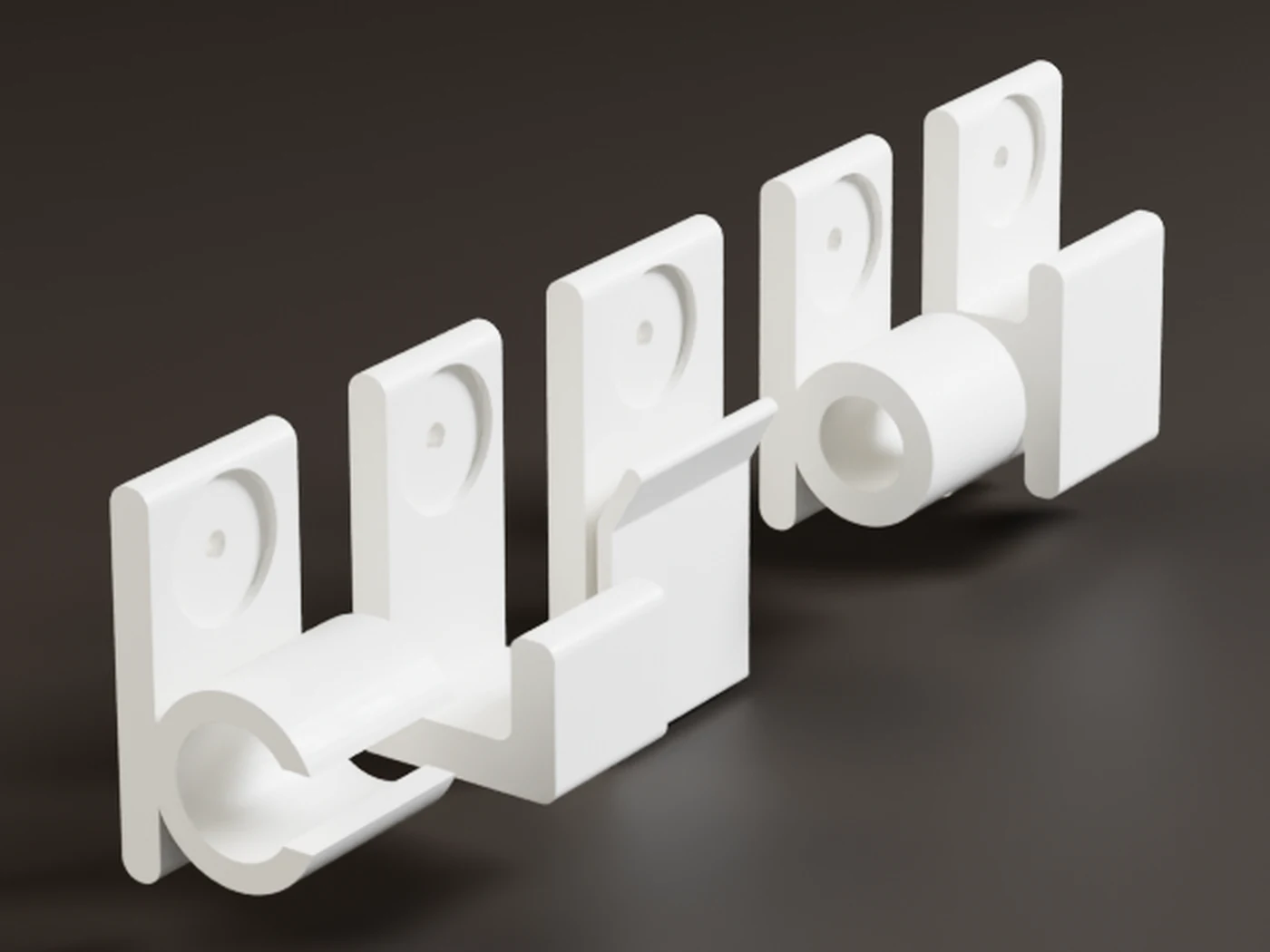
That is why every fitting on our pin shelf has a flat back big enough for a 20 mm square of tape. Pin it, tape it, or do both, and the choice is yours at the point you put it up rather than ours at the point we drew it.
When a printed clip is worth it, and when it is not
Most of the time it is not, and we would rather say so. A bag of five hundred nail-in cable clips costs a few dollars, and if you are allowed to put a nail in your wall and a stock size fits your cable, buy the bag. The same goes for adhesive hooks on a clean painted wall: they are cheap, they work, and they are sold in every hardware shop in the country.
A made-to-order clip earns its place in the narrow cases where the stock one does not exist. A cable that no stock bore fits. A wall you are not allowed to nail. A cubicle panel where an adhesive hook will not stick to fabric. Or a shape nobody sells at all: search for a push-pin cord keeper or a push-pin clip that holds paper without piercing it and you will find adhesive pads and cubicle hooks, because nobody makes the thing you were looking for.
Getting a pin in and out without wrecking anything
- Push straight in, perpendicular to the wall. A pin driven at an angle tears a slot instead of making a hole, and the slot is what lets it work loose.
- Press on the fitting, not on the thing you are hanging.
- To remove, pull straight out. Rocking it side to side enlarges the hole and guarantees the next pin in that spot will not hold.
- Do not reuse the same hole. Move over five millimetres and start a fresh one.
- On a hard plaster or a plaster-over-brick wall, a pin may not go in at all. That is the wall telling you to use tape or a rail.
How 3D3D handles it
We make the fitting for the case the shop does not stock: a bore cut to your cable rather than to the nearest of three, a clip that holds paper without a pin through it, a cleat you can wind a whole extension lead onto. Every one is printed to order, so the size is a number rather than a redesign.
What we will not do is put a weight rating on a push pin. We have not load-tested one, the answer depends on a wall we have never seen, and a figure we did not measure is not worth having. Hang light things, keep them close to the wall, and if it matters, find the stud.