Why anyone leaves wire behind
Coated wire lifelines fail from the inside. Water gets under the plastic, the strands corrode where nobody can see them, and the first sign is often a broken wire under someone's weight. That is why offshore rules put a life on them at all.
Uncoated Dyneema does not hide its condition. It chafes visibly, it does not rust, it is lighter, and it can be spliced with your hands on the boat instead of swaged in a shop. The trade is that it needs UV protection and it creeps a little under sustained load, which is exactly what the lashing is there to take up.
How the assembly actually goes together
- A deadeye is spliced or lashed into each end of the line, so the line turns around a large radius instead of a hard corner.
- A short length of smaller line, the lashing, is rove back and forth between that deadeye and a fitting on the stanchion, pulpit or pushpit, four or five passes.
- You pull the lashing hand tight, then take up the last of it with a couple of round turns and hitches. No turnbuckle, no swage, no rigger.
- Every two or three years you cut the lashing off and reeve a new one. The lifeline itself stays.
What the deadeye has to do
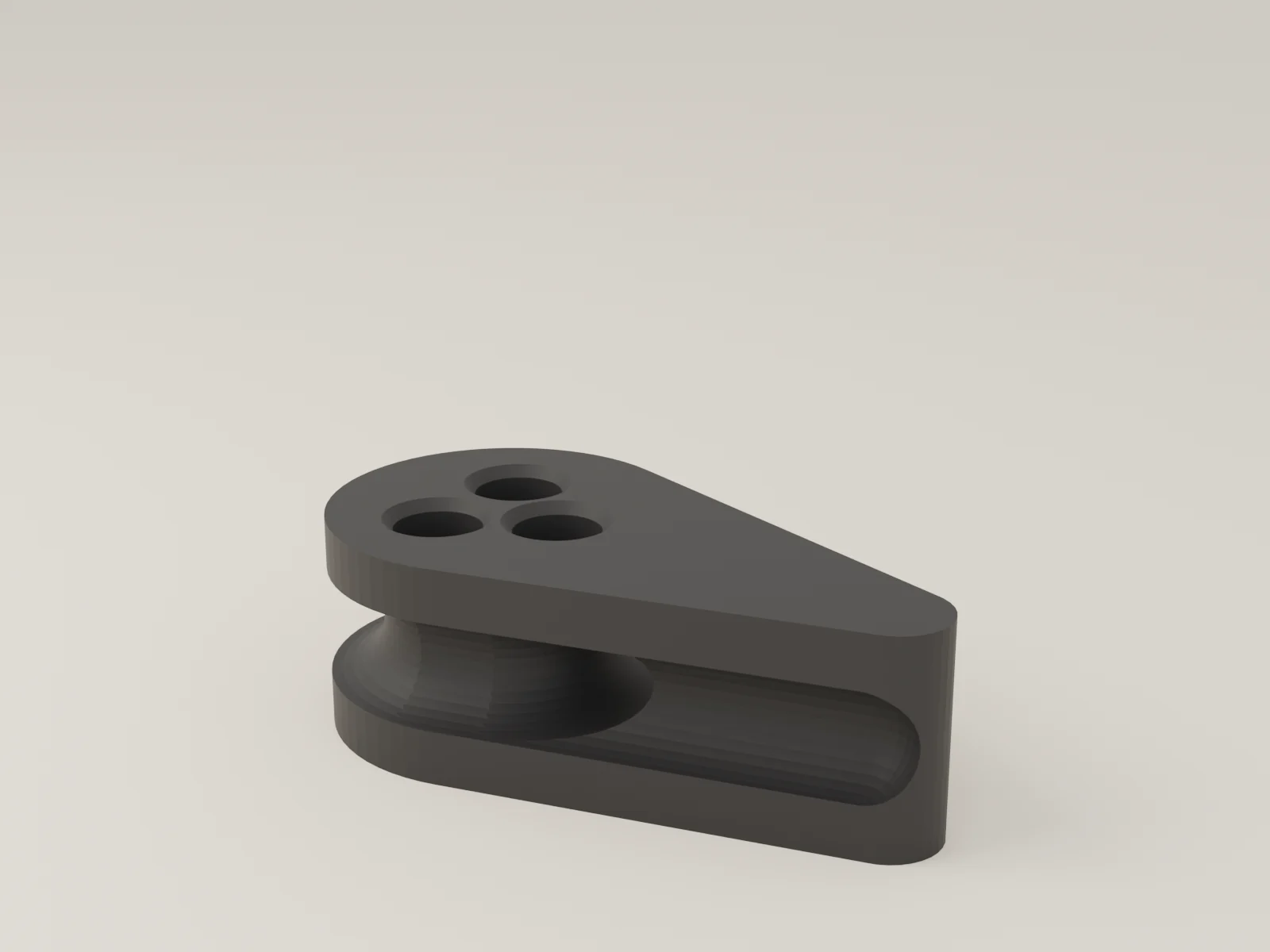
It has one job: turn the line through as large a radius as it can without letting it slip sideways off the groove. A synthetic line loses strength fast when it is bent tightly, so a groove cut to the line diameter, carried around the full perimeter, is worth more than any amount of bulk.
The second thing that matters is the edges of the lashing holes. A lashing takes the full tension of the lifeline across a few millimetres of bore, moving slightly with every wave. A sharp edge there is a knife. Countersinking both faces of every hole costs nothing to print and it is the difference between a lashing that lasts its three years and one that chafes through in a season.
Materials, and why not everything survives this
- PLA: fails in a season outdoors. It chalks under UV, it creeps under sustained load, and this part is under sustained load by definition.
- PETG: better outdoors, but it creeps under continuous tension, which is the one thing a lifeline termination never stops doing.
- ASA: UV stable and the right answer for most marine parts on a boat, including enclosures and deck fittings.
- PA-CF, nylon carbon fibre: stiff, fatigue resistant and the best strength to weight we run in house. It is what we print deadeyes in, and it is the reason the part can be small enough to look like the machined ones without behaving like plastic.
Fitting yours
Measure the line you are actually using, not the line you meant to buy. The groove is cut to that diameter, so a 5 mm Dux and a 6 mm braid get different parts. Tell us the diameter and how many lashing passes you want to take, and that is the whole specification.
One more thing worth saying plainly: a lifeline is a safety item. If your boat is raced under a rule, check the rule before you change anything, because some categories still specify what a lifeline may be made of and how it may be terminated.
The short version
Deadeye at each end, lashing in between, replace the lashing not the line. Get the groove radius and the hole chamfers right and the rest is knots.