3D3D Contact

Materials guide

Every material we stock,
priced in the open.

Thirteen materials. Two rates. No mystery markup. The right call for marine, structural, flexible, or decorative work — confirmed in your quote before you spend a dollar.

We stock thirteen 3D printing materials from flexible TPU to carbon-fibre-reinforced ASA, each priced per gram at two transparent rates. Pick by environment — sun, salt, flex, or load — and we confirm the exact material and cost in your quote.

Multi-spool filament rack with a range of materials loaded and ready

In-house · New Brunswick

Every spool on this rack is in the shop right now.

PLA through ASA-CF — printed on our own hardware, to our own quality standard. High-temp materials (PEEK, PEI, PPS) are coordinated through a vetted partner and quoted transparently.

Get a quote
Open pricing

What does each material cost per gram?

Customer pricing applies to any single order. Maker pricing unlocks at 20+ identical units. Both rates include material — machine time and shipping are itemised separately on every quote. Prices in CAD.

MaterialCustomer /gMaker /gBest for
PLA$0.09 /g$0.06 /gPrototypes, fit checks, display models
PLA+$0.12 /g$0.08 /gTougher prototypes, snap-fits, housings
PLA Specialty$0.14 /g$0.09 /gGalaxy, silk, wood-fill — visual/display
PETG$0.11 /g$0.07 /gOutdoor parts, general functional use
TPU 95A$0.18 /g$0.12 /gSeals, bumpers, grips — firm flex
TPU 87A$0.20 /g$0.13 /gHatch seals, dock fenders — soft flex
ABS$0.13 /g$0.08 /gHeat-facing parts, enclosures, smooth finish
ASA$0.13 /g$0.08 /gMarine and outdoor — UV-stable, no yellowing
PC$0.32 /g$0.22 /gHigh-impact structural, sustained 120 °C
PLA-CF$0.30 /g$0.21 /gStiff, lightweight brackets — easy post-process
PETG-CF$0.35 /g$0.25 /gStiff structural, drone frames, marine load
ASA-GF$0.28 /g$0.19 /gStiff + UV-stable outdoor structural
ASA-CF$0.38 /g$0.27 /gMarine structural — stiff + UV-stable + light

Maker rate: 20+ identical units per order. Machine time and shipping quoted separately. More materials available on request — if you don't see yours, email us.

Material properties

Which filament handles my project?

Each material has a specific operating envelope — temp range, stiffness, UV stability, flexibility. Here is the full detail for every material we stock.

Orange filament spool on a 3D3D branded printer
PLA 180 – 220 °C

Polylactic Acid

1.24 g/cm³

  • Excellent dimensional accuracy
  • Low warp on open printers
  • Biodegradable, low odour

Best for: Prototypes, fit checks, display models, artwork

Softens around 60 °C — not for heat-facing parts.

PLA+ 200 – 230 °C

PLA Plus (enhanced)

1.24 g/cm³

  • Stronger impact resistance than standard PLA
  • Better layer adhesion
  • Still easy to sand and paint

Best for: Functional enclosures, snap-fits, consumer housings

Drop-in upgrade from PLA when parts need to survive daily handling.

PETG 230 – 250 °C

Polyethylene Terephthalate Glycol

1.27 g/cm³

  • ~80 °C continuous heat resistance
  • Low shrinkage, minimal warp
  • Good chemical resistance

Best for: Outdoor functional parts, general engineering brackets, containers

Food-safe grades available — confirm in quote request.

TPU 95A 220 – 240 °C

Thermoplastic Polyurethane · Shore 95A

1.21 g/cm³

  • Firm flex — compresses under load, springs back
  • Excellent abrasion resistance
  • Good oil and UV resistance

Best for: Gaskets, vibration dampeners, grip sleeves, protective bumpers

95A is firm enough to hold shape under most loads.

TPU 87A 220 – 235 °C

Thermoplastic Polyurethane · Shore 87A

1.20 g/cm³

  • Noticeably softer and more conforming than 95A
  • Excellent tear resistance
  • Seals complex geometry reliably

Best for: Hatch seals, dock fenders, line stoppers, wearable components

Choose 87A when the part needs to squeeze into a gap or conform to a curved surface.

ABS 230 – 250 °C

Acrylonitrile Butadiene Styrene

1.05 g/cm³

  • ~100 °C continuous heat resistance
  • Can be acetone-vapour smoothed
  • Widely used — easy to source replacements

Best for: Heat-facing enclosures, automotive parts, post-processed display work

Printed in an enclosure to prevent delamination. Good long-term durability.

ASA 240 – 260 °C

Acrylonitrile Styrene Acrylate

1.05 g/cm³

  • UV-stable — holds colour and structure outdoors for years
  • ~100 °C heat resistance
  • Salt-spray and moisture resistant

Best for: Marine and outdoor parts, signage, anything that sees sustained sun and salt

The default choice for anything going outside on a boat or dock.

PC 260 – 300 °C

Polycarbonate

1.20 g/cm³

  • Exceptional impact strength — nearly unbreakable at practical part sizes
  • Sustained 120 °C heat resistance
  • Optically clear grades available

Best for: High-load structural brackets, under-hood automotive, transparent panels

Requires a hardened nozzle and enclosure. We have both — factor a small surcharge for setup.

PLA-CF 200 – 230 °C

PLA Carbon Fibre

1.30 g/cm³

  • Significantly stiffer than plain PLA without the weight penalty
  • Excellent surface finish for a CF material
  • Easy to sand and drill post-print

Best for: Lightweight stiff brackets, precision parts, jigs and fixtures

Best CF choice when heat resistance isn't critical. Easier post-processing than PETG-CF or ASA-CF.

PETG-CF 235 – 255 °C

PETG Carbon Fibre

1.30 g/cm³

  • ~40 % stiffer than plain PETG
  • Low weight, high stiffness-to-mass ratio
  • Good chemical and moisture resistance

Best for: Structural marine parts, drone frames, stiff load-bearing brackets

The go-to when you need a stiff part that lives outdoors without UV degradation concerns.

ASA-GF 245 – 265 °C

ASA Glass Fibre

1.35 g/cm³

  • 25–35 % stiffer than plain ASA
  • UV-stable, holds colour outdoors
  • Better dimensional stability under load
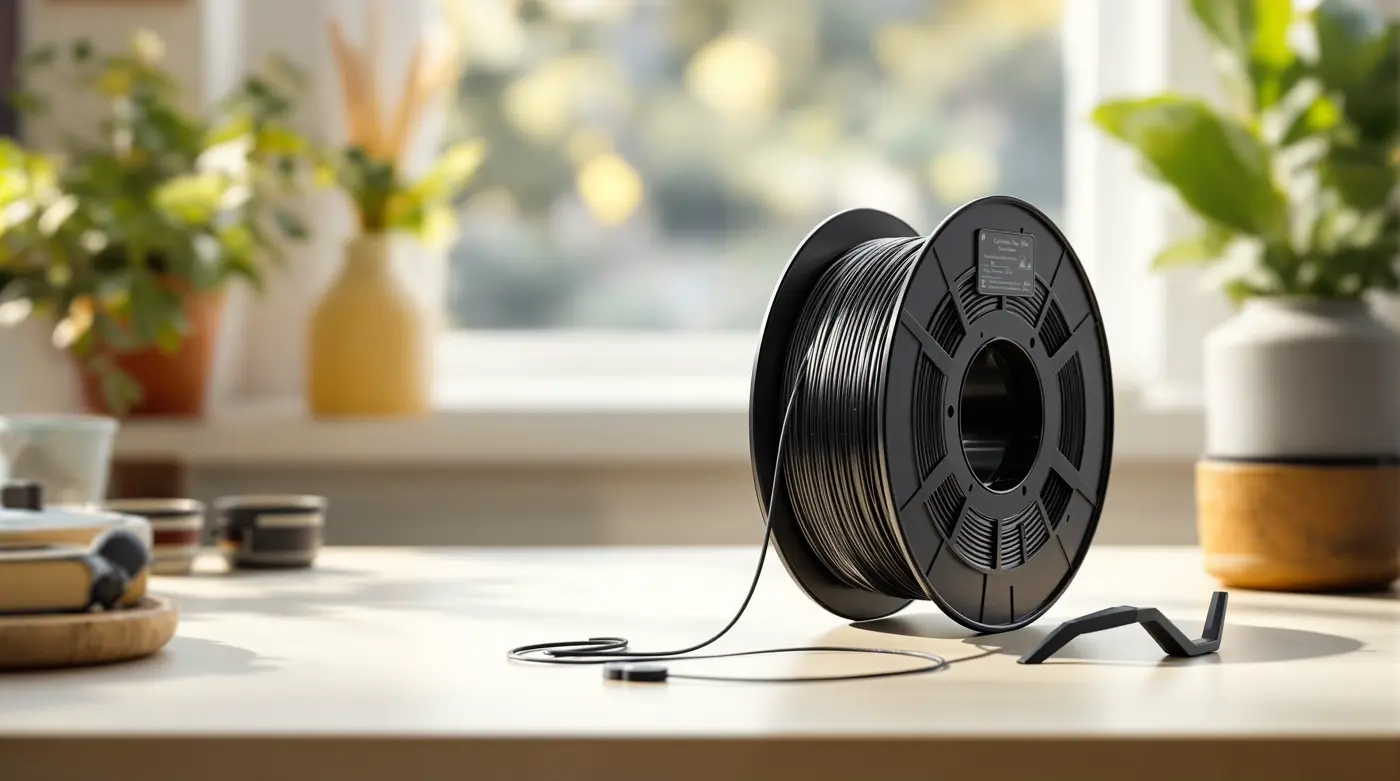
Best for: Structural outdoor parts where stiffness and weathering resistance both matter

GF adds stiffness at lower cost than CF while keeping full ASA UV resistance.

ASA-CF 245 – 265 °C

ASA Carbon Fibre

1.35 g/cm³

  • Best of both — CF stiffness + ASA UV stability
  • Lightweight, strong, weather-proof
  • Hardened nozzle required (we have it)

Best for: Marine structural parts, load-bearing outdoor brackets, race and performance applications

Premium choice for marine environments. Stiff, light, and UV-stable — nothing else checks every box.

+MORE on request

Need something not listed?

HIPS · Nylon · PVA · Specialty grades

  • HIPS for dissolvable support structures
  • Nylon 12 for engineering applications
  • PVA for complex support removal
  • Specialty and limited-edition filaments by arrangement

Contact us: If your job needs a specific material grade, email [email protected] with the requirement. We source, confirm compatibility, and quote transparently.

Email the shop
The print fleet

What printers do we run?

Six machines, each chosen for a specific capability gap. The Prusa Core One L handles the full engineering material list. The others add speed, build volume, and multi-colour capability. The right printer is assigned automatically per job.

Prusa Core One L — 3D3D print fleet

Sponsored by Prusa Research

Prusa Core One L

The workhorse. Hardened-steel nozzle, precision temperature control. Handles everything from flexible TPU to carbon-filled PETG without compromise.

Build volume
350 × 350 × 350 mm
Max nozzle
320 °C (high-temp hotend)

PLA · PLA+ · PETG · TPU · ABS · ASA · PETG-CF · PLA-CF · ASA-CF · ASA-GF · PC

Creality K1 (modified) — 3D3D print fleet

High-speed production

Creality K1 (modified)

Modified for production throughput. Best-in-class speed for PLA and PETG runs. Good for rapid iteration and short-run production.

Build volume
220 × 220 × 250 mm
Max nozzle
300 °C

PLA · PLA+ · PETG · ABS · ASA

Anycubic Kobra 2 Max — 3D3D print fleet

Large-format prints

Anycubic Kobra 2 Max

Oversized build volume for large decorative pieces, bulkhead panels, and marine fascias that need to print in one piece.

Build volume
420 × 420 × 480 mm
Max nozzle
260 °C

PLA · PLA+ · PETG · TPU · ABS

Bambu A1 — 3D3D print fleet

Multi-colour precision

Bambu A1

Precision multi-colour capability. Used for branded and colour-specific parts where layer accuracy and colour registration matter.

Build volume
256 × 256 × 256 mm
Max nozzle
260 °C

PLA · PLA+ · PETG · TPU

Bibo 2 — 3D3D print fleet

Dual-extrusion specialist

Bibo 2

Dual-extrusion for two-material or two-colour prints in a single pass. Useful for soluble support removal on complex geometries.

Build volume
214 × 186 × 160 mm
Max nozzle
260 °C

PLA · PLA+ · PETG · ABS · ASA

Original fleet member

Original fleet member

Prusa MK2.5S

The original. Still in rotation for smaller runs. Reliable and proven — Prusa's bed levelling and filament detection make it a solid backup unit.

Build volume
250 × 210 × 200 mm
Max nozzle
300 °C

PLA · PLA+ · PETG · ABS

The Prusa Core One L is sponsored by Prusa Research — the reason we can run the full engineering material list in-house, with the precision a production run needs.

Above 320 °C

What about high-temp engineering materials?

Materials that require sustained nozzle temperatures above 320 °C need specialist hardware we do not own in-house. We coordinate those jobs through a vetted partner.

What needs a partner

Specialist materials

  • PEEK — ≈ 380 °C nozzle, enclosed heated chamber
  • PEI / ULTEM — ≈ 360 °C, aerospace-grade stiffness
  • PPS / PPSU — ≈ 360 °C, chemical and flame resistance

These jobs require a written quote and partner scheduling. Lead time varies. Email us first — we will tell you whether the job actually needs a high-temp material, or whether ASA-CF or PC can do the same thing at a fraction of the cost and turnaround.

How it works

  1. 01You email the requirement — material, geometry, quantity.
  2. 02We review and confirm whether it genuinely needs high-temp, or whether a lower-temp alternative works.
  3. 03If high-temp is required, we coordinate with the partner and send you a full quote at cost — no markup.
  4. 04You approve, we coordinate production, you receive the parts.
Email the requirement

Ready to print

The right material.
The right price.
Quoted before you commit.

Send dimensions, a photo, or a file. We confirm the material, calculate the weight, and quote the total before you approve anything. Ships from New Brunswick — anywhere in Canada and worldwide.

Straight answers

Questions about materials and pricing.

What is the difference between customer and maker pricing?
Customer pricing applies to one-off and small orders. Maker pricing applies to orders of 20 or more identical units in the same material. We confirm which tier applies in the quote — you see it before you approve anything.
Do you carry PLA-CF, ASA-CF, and ASA-GF?
Yes. PLA-CF, ASA-CF, and ASA-GF are all in stock and in-house. ASA-CF is our preferred choice for marine structural work — stiff, UV-stable, and lightweight. Mention the material in your quote request and we will confirm.
Which TPU hardness should I choose?
For most seals, bumpers, and grip surfaces, Shore 95A is the right call — firm enough to hold shape, flexible enough to absorb impact. For parts that need to conform tightly to a curved surface or seal under low compression (hatch seals, dock fenders), Shore 87A gives a softer, more pliable result. Describe the application and we will recommend the correct grade.
What about Polycarbonate (PC)?
We print PC in-house. It requires a hardened-steel nozzle and an enclosure, and we have both. PC is the right choice for parts that need to take a hard impact or sustain temperatures above 100 °C. A small setup note will appear on your quote — there is no extra mystery charge beyond the per-gram rate.
What does 'farmed out' mean for high-temp materials?
Materials that require sustained print temperatures above 320 °C — PEEK, PEI/ULTEM, PPS/PPSU — need a specialist enclosed chamber and dedicated nozzle alloy. We coordinate with a vetted partner and pass the cost through at cost, no markup. These are quoted per job. Email us first — we will tell you honestly whether the job actually needs one of those materials or whether ASA-CF or PC can do the same thing at a fraction of the cost.
Can I specify a filament brand or colour?
Yes. Mention brand or colour in your quote request and we will confirm availability or suggest a close match. Specialty filaments not in current stock may add a lead day or two.
How do I know how many grams my part weighs?
Send a photo and dimensions. We calculate weight from the slicer and include it on your quote — you see the gram count, the material, and the total before you approve anything. There is no guesswork.
Which printer handles which materials?
The Prusa Core One L handles the full material list including engineering grades, CF materials, and PC. The Creality K1 is optimised for speed on PLA/PETG production runs. The Anycubic Kobra 2 Max handles oversized single-piece prints. The printer is selected for your job automatically — if a specific printer matters, note it in the request.