Why the break has to be there at all
A masthead run carries the tricolour, the anchor light, the wind gear and often the VHF coax, and every one of them terminates somewhere below deck. If the run is continuous, unstepping the mast means cutting it. Do that twice and the wire is too short to reconnect, which is how a winter haul-out turns into a rewire.
So the run gets broken at the mast base, above the deck, and the two halves meet at a connector. The question is never whether to break it. The question is what you break it with.
What people actually use, and how each one fails
- A trailer plug. Cheap, keyed, and everywhere. The pins are plated steel and the housing is not sealed, so a season of salt spray turns the contacts green and the anchor light starts flickering in a following sea.
- A hardware-store outdoor junction box. Genuinely waterproof from above, and usually the right answer for the enclosure. It is rarely the right shape: the gland positions fight the mast section and the lid needs more clearance than the boot allows.
- Terminal blocks in a drip loop with nothing over them. Works for years in fresh water and fails fast in salt.
- Bare crimps and heatshrink. Not a break at all: it has to be cut to unstep.
What water actually does to a mast base connection
Water does not usually enter the connector from above, because most people get the drip loop right. It arrives as condensation inside the mast and as spray driven up under the boot, and it sits in the bottom of whatever enclosure you used because that is the low point of the whole run.
That is why a box needs a way for water to leave. A sealed box with no drain is a reservoir, and the terminals live at the bottom of it.
What a purpose-built box has to do
- Take the cable count a mast actually carries, with room for the coax, which is stiffer and has a bigger bend radius than anything else in the bundle.
- Mount to the mast section or the deck without a new hole in either, or with fixings that seal properly if it needs them.
- Drain. Whatever gets in has to get out lower than the terminals.
- Survive UV. This is the one people miss on a printed part: PLA and PETG chalk and go brittle in a season of sun. ASA holds colour and strength outdoors for years, which is why every marine part we print is ASA.
- Come apart with the tools already on the boat.
On printed parts in this job
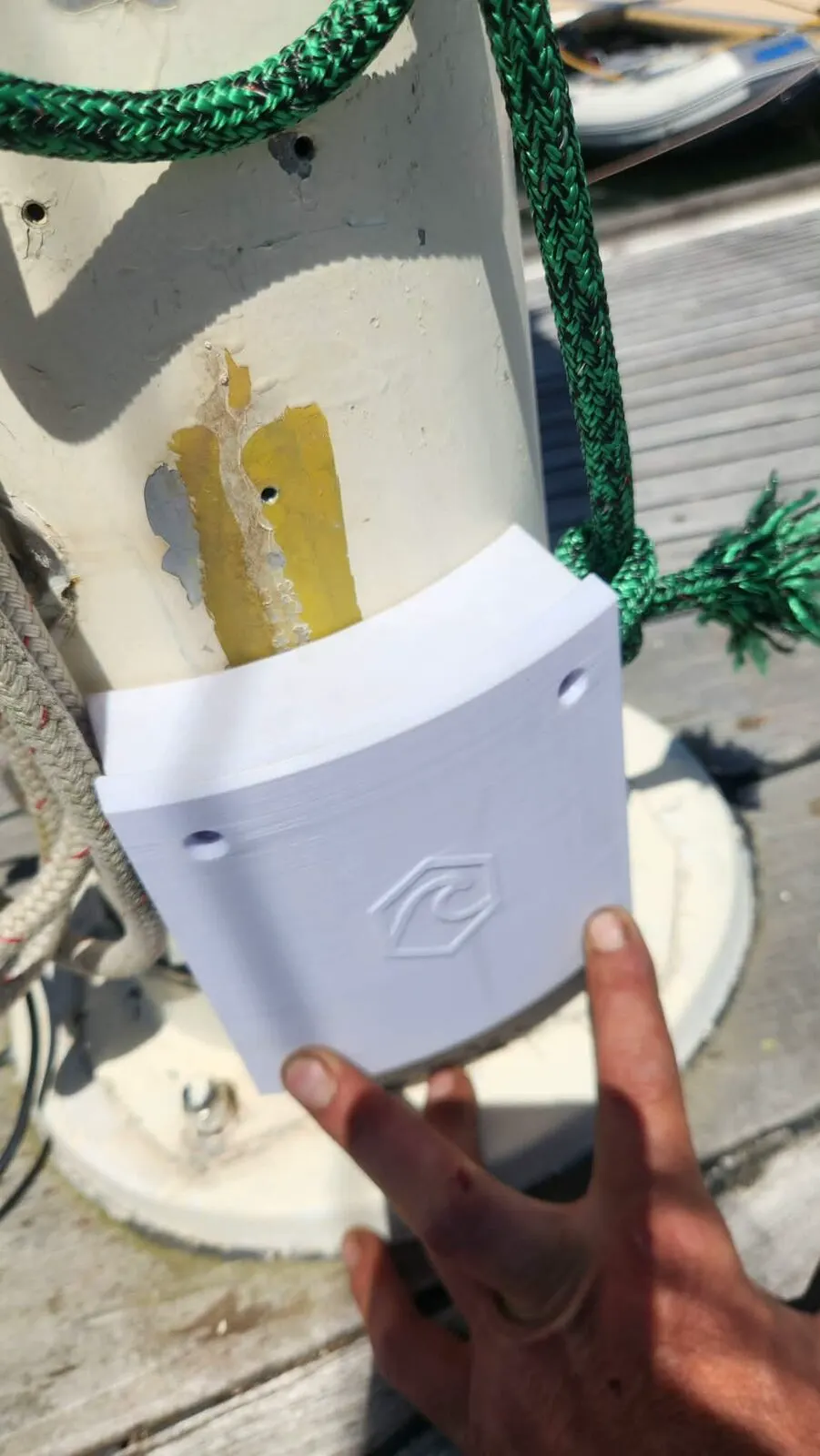
A junction box is a good candidate for printing because the shape is boat-specific and the volumes are one. It is a bad candidate for the wrong material: the part lives in UV and salt, so it is ASA or it is a season.
We print these to order in ASA and size them to the mast and the cable count rather than to a catalogue. If yours is an odd section or you are running more circuits than usual, that is the normal case rather than a special one.
The short version
Break the run at the mast base, keep the terminals above the water that will inevitably arrive, give that water somewhere to go, and use a material that does not mind the sun. Everything else is preference.